Thursday, 24 May 2012

Rocks and Weathering


Last week we started a new topic - The Rock Cycle - by looking at what rocks are, and the processes of chemical and physical weathering (how rocks are worn down, or eroded). What you need to know is covered in the following Bitesize pages:

Bitesize - What are rocks?
Bitesize - Weathering

Here is the homework sheet, due in on Monday's lesson:
Page 1 and page 2.

Wednesday, 23 May 2012

Homework Updated - 23rd May

By next Monday 28th May:

Finish the sheet we started today on rocks and weathering processes.

Ensure that you have submitted both Energy Resources tasks in Edmodo (see post below).

Monday, 30 April 2012

Renewable Energy Independent Task


A movie poster displays industrial smoke stacks whose emissions form a hurricane eyewall
Having discussed different forms of energy, and different energy resources, we are now considering the arguments for and against switching to renewable energy resources.

 
Task 1:
Produce a campaign poster alerting people to the environmental dangers associated with burning fossil fuels.
This should include:
  • What fossil fuels are
  • How they form
  • What is produced when they burn
  • What could happen to the Earth as a result
  • What the scientific evidence for this is
Bitesize climate change.
Bitesize 'changes in the environment' activity
Bitesize changes in the environment test.
Bitesize non-renewable energy sources.
Bitesize renewable energy sources
Bitesize energy activity.
Bitesize energy test.

The second part of this task is to produce a report outlining to the government what you recommend they should do about meeting the UK's energy needs in the future. This should include the following:
  • Title: 'Towards a Renewable-Energy Future'
  • A list of different renewable energy resources that could be used in the UK, with illustrations.
  • Benefits and disadvantages of each one.
  • Your recommendation as to which would be the best choice to invest in, and why.
 
You can now submit your first draft of your work through edmodo. Once you have received feedback on this your homework is to make the suggested improvements to your poster.

Thursday, 23 February 2012


We have been looking at some different reactions recently. Design a leaflet explaining either how combustion reactions work or how neutralisation reactions work.  Your explanation should include what you might see during this reaction; the chemistry behind this; whether the reaction is exothermic or endothermic and why you think this. It would be useful to include a word equation in your leaflet.


Your leaflets should be handed in by the 5th of March.

Thursday, 26 January 2012

Periodic Table Work

We have been looking at elements and the periodic table recently.

I would like you to choose an element of your choice and produce an A4 poster on it.
It should include the name of the element; the chemical symbol and at least two uses of this element.

There are also some useful revision activities on atoms, elements and compounds and the periodic table on the BBC Bitesize website: http://www.bbc.co.uk/schools/ks3bitesize/science/chemical_material_behaviour/atoms_elements/revise1.shtml


Wednesday, 11 January 2012

Light homework tasks

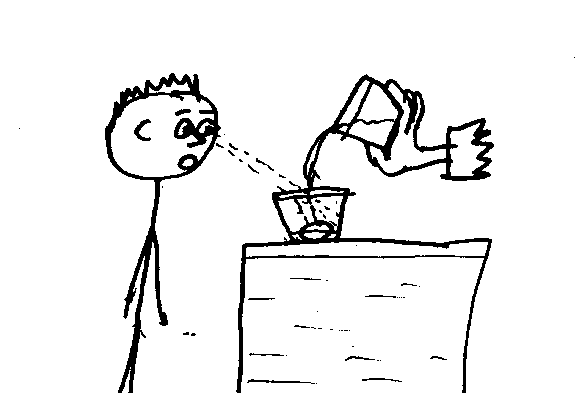
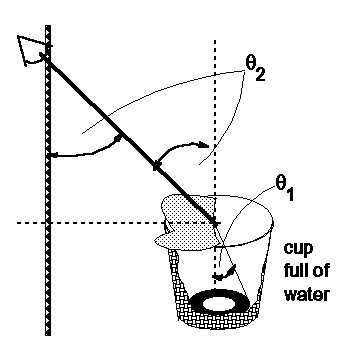
Today we looked at an example of refraction when water is added to a cup. Your first task is to show this to someone at home, and explain what happens with a diagram. For it to work you have to make sure that their head stays still, with the dot or other mark on the bottom of the cup just hidden from view by the rim of the cup. Then pour water quickly into the cup until it's nearly full (measure the amount of water out first) and the dot should appear. These pictures might help you to explain:
figure

Your second task is to produce a design for a light show for a concert on a piece of A4 paper, showing how you could use colour mixing, reflection and refraction to produce interesting lighting effects. Use ray diagrams (make sure your light rays are drawn with a ruler and have arrows to show the direction of the light) to show how the light travels. Remember that you can produce colours by splitting white light with prisms, and by mixing the three primary coloured lights. You can use filters to block out certain colours. Refraction could be used to bend light.


Both tasks are due to be completed by next Wednesday 18th January.